PRCA 3711/4711 Portfolio Review

Sign up for an appointment for your portfolio review. The times listed in the Google Doc are the ONLY ones that will be available. There are slightly more times than we have students in PRCA 3711/4711. [As of 3:00 on November 4, about half of the spots are already taken.] The review will take about 10 minutes total.

Bring along your professional-looking portfolio with several samples of your best work, along with your resume. Review Portfolios for Public Relations Students for a reminder of how to assemble your portfolio.

Tips

Dress professionally, as you would when you go to a job interview.

Carry only the things you would for a “real” job interview (no backpacks or bulky purses).

Present the team with your business/social card, if you have one.

Expect some or all following questions:

  1. Tell me a little about yourself.
  2. What are you doing to keep current on public relations trends?
  3. Show me two pieces in your portfolio that you’re most proud of. Tell me about them.
  4. If you’re not yet published, what are your specific plans for getting published?
  5. Think about a time you were a part of a team completing a project. How did it go?
  6. All of us have some pluses and minuses in our performance; what are some of yours?
  7. After our interview today, I am going to look you up online. How do you think my impression of you will change after I do this?
  8. How do you want us to remember you?

Share a few questions that you would want to ASK in a real job interview.

Prepare a “leave-behind” for the review team, with two or three pieces you’re most proud of and a revised version of your resume. Package these items professionally. NOTE: You will NOT leave your entire portfolio with the team. The only time they will see your portfolio is during the brief time that you are together.

Points Breakdown

  • Poise, Professionalism & Confidence: 50 points
  • Portfolio Presentation: 100 points
  • Interview Q&A: 50 points

The WII-FM Factor for Twitter

The PRSSA (Public Relations Student Society of America) at Georgia Southern University asked me to join them for tonight’s meeting and share with them one of my favorite subjects: Twitter! How could I say no? 

To see my notes on the slides, you can download the presentation or view it at SlideShare.

A Twitter Starter Pack for PR Students

confused twitter birdAre you a public relations student (or recent grad) just getting started using Twitter? It’s usually best to test the waters a bit before you dive in. Try following some (or all) of these people or organizations in my Twitter Starter Pack for PR Students. They all have something in common: they tweet useful or interesting information for people involved in public relations. Read their tweets for a few days before you start tweeting yourself.

You may also want to read these two blog posts I’ve written about Twitter: Choosing Whom to Follow on Twitter: My Strategy and A Twitter Lexicon. And I’d be remiss if I didn’t recommend Prof. Sam Bradley’s College Student’s Guide: Twitter 101.

Questions?

barbara_is_listening

(PS: Suggestions for other good people for PR students to follow? Please let me know with a comment to this post.)

GSU Registration Override Form :: Fall 2010

If you are requesting an override for one of Prof. Barbara Nixon’s courses, please complete and submit this form AND send an e-mail letting her know that you’ve completed a form. (Note: If the form doesn’t automatically load within the body of this blog post, you can access it here instead.)

Help Create a Pixelated Conference :: Social Media 101

Dr. Natalie Tindall, Georgia State University, takes it all in.

In the spring, I’ll be teaching an online course for Georgia Southern called Social Media for PR. One of the things I plan to incorporate into the course is video/audio from respected leaders in PR on the topic of social media — like what the students might experience if they went to a conference. There are many, many videos (and audio recordings) of conference speakers online now, but where to start?

Mitch Joel created something at his blog Six Pixels of Separation called a Pixelated Conference, where he embedded video clips from many different conferences. And that got me thinking . . .

If you were going to create a Pixelated Conference on Social Media for PR students, what would you include? Please offer your suggestions here, and I’ll share a link to what I create for my students when I get it ready.

Some suggestions I’ve heard so far:

Thanks in advance for your thoughts!

[Photo Credit: http://ugaconnect2009.wordpress.com/2009/09/19/pr-is-not-social-media-and-more-words-to-tweet-by-from-lauren-fernandez/]

TED :: Peter Donnelly shows how stats fool juries

In today’s PRCA 4330 (PR Research) class, the instructor PC didn’t seem to have the correct version of Flash to show this video. It’s a fascinating talk where “Oxford mathematician Peter Donnelly reveals the common mistakes humans make in interpreting statistics — and the devastating impact these errors can have on the outcome of criminal trials.”

How to Lie with Design Research

“Dan Saffer at the sixth annual IIT Design Research Conference, held September 21-22, 2007 at the Museum of Contemporary Art, in Chicago. ABSTRACT: How to Lie with Design Research: Same Data, Different Findings “There are three types of lies: lies, damn lies, and statistics.” Thus said Mark Twain. Should we add “Research Findings” to the list? Experience shows that, especially with qualitative research like the type designers often do, two researchers can look at the same set of data and draw dramatically different findings from them. How do we deal with this? If the findings are in conflict, who is correct? Is there a way to make our findings more objective, or is the nature of qualitative research such that subjectivity (what some might call lying) is always necessary?”

Statistically Speaking, That’s Funny!

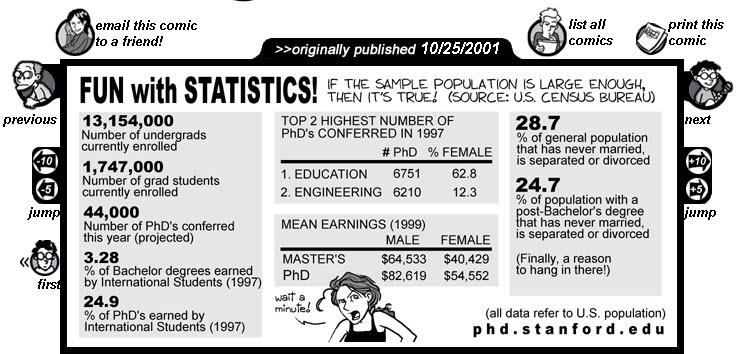
Statistics can scare even the bravest PRCA 4330 student . . . so let’s look on the lighter side. Using your best search skills, find one or more funny cartoons (or YouTube videos) on the topic of statistics or math.

Here’s one of my favorites, from the PhD (Piled Higher & Deeper) comic strip:

fun with statistics

Reply with a comment to this post, giving a link to the cartoon or video — or if you’d prefer, a link to your own blog, where you’ve embedded the funny item. We’ll share the best ones in class on Wednesday afternoon.

Branding Gone Bad :: #PepsiFail

pepsifail

UPDATE @ end of this post

Did you see that Pepsi Co. has released an iPhone app for its Amp energy drink? It’s called … wait for it … Amp Up Before You Score.  (I intentionally did not link to the app, as I don’t want to drive traffic its way.)

In theory, having an app (not this one) for your brand could be smart, maybe even cool. But when you see what the app does, you may change your mind.

InventorSpot describes the offensive app in this way:

Here’s how it works:

1. Identify Her Type: Got your eye on a girl, and aren’t sure how to get started? Pick out her profile, flip the card, and study up quick with a cheatsheet on the stuff she’s into, with lists, links and some surefire opening lines. (Surefire to what, we won’t say.)

2. Keep a List: Get lucky? Add her to your Brag List. You can include a name, date and whatever details you remember.

3. Brag: You got it? Flaunt it. Keep your buddies in the loop on email, Facebook or Twitter. Here’s who you get:

Artist Aspiring Actress Athlete Bookworm Businesswoman Celebrity Cougar Dancer Foreign Exchange Student Goth Girl Indie Rock Girl Married Military Girl Nerd Out-Of-Your-League Girl Political Girl Princess Punk Rock Girl Rebound Girl Sorority Girl Treehugger Trouble Twins Women’s Studies Major

If you have an iPhone or iPod Touch, take a look at the app. And see what people are saying about “Amp Up Before You Score.” Make up your own mind about the app. But for me, I am disappointed in PepsiCo. I expected better from a company like this.

Put in Twitter terminology, it’s a major #PepsiFail.

[Hat tip to Liz Pullen for calling my attention to this iPhone app.]

UPDATE as of 3:00pm on October 12:

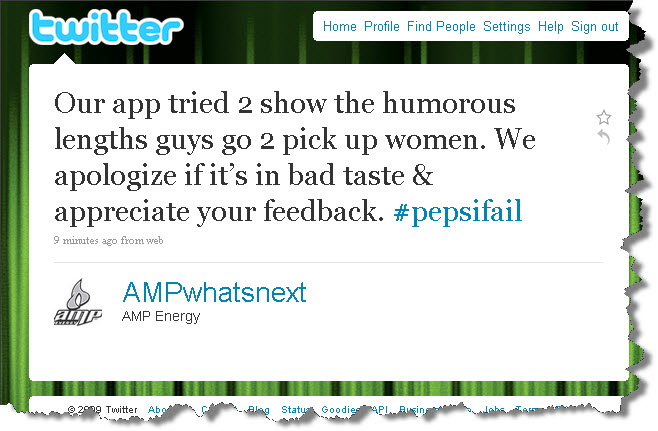
Just a few moments ago, the Twitter account for AMP (@AMPwhatsnext) posted an apology for the “Amp Up Before You Score” app. As far as 140-character apologies go, it’s a good one. I’ve already sent AMP my feedback.

AMP's Apology

Um, Hot Enough for You Today?

Catsitter Ken and Catsitter Barbie by abbyladybug.Going to networking events, or even meeting someone for the first time, can feel awkward for even the most socially adept people. Getting the conversation started is often the most challenging part. Starting a conversation by referring to the weather was lame 20 years ago, and it’s still lame today (unless you’re meeting Lee Haywood, meteorologist for WSAV in Savannah, then it’s kinda okay).

Chris Brogan, in his September 29 Chris Brogan Behind the Scenes e-mail newsletter, shared five ideas for conversation starters.

  1. “So, what are you into when you’re not hanging out at social events like this?” I use a variation on this often. It lets the person talk about themselves without asking the dreaded, “What do you do?” (I loathe that question. My answer? “I type.”)
  2. “Do you ever wonder what Adam West is doing right now? Me neither.” A non sequitur accomplishes a few things. It sets a level of the other person’s sense of humor, their pop culture knowledge, and many other things. Just replace “Adam West” with whatever fringe character you want to use to identify what the person might share in common with you.
  3. “I’m always unsure what to say at events like this, so I thought I’d start with ‘hi.'” You can’t get much simpler than this. It lets the other person know you feel just a hair awkward, but it’s straightforward and direct, and lets them know you’re hoping to say a few things. Follow this up with, “I’d love to know more about what you’re into.”
  4. “You look like the kind of person who has a different opinion than the mainstream. What’s your take on this so far?” This sets yourself up for talking with the kinds of people who always offer the biggest value to your perspective.
  5. “What were you doing three years ago?” This one sets a person back a moment. They tend to either answer with a wistful smile or a guarded “who wants to know?” You learn something from this exchange, too.

If you find it challenging to start a conversation, perhaps one of Chris’ ideas will work for you. For me, I’d probably adapt #2 to say “Do you ever wonder what Ron Palillo is up to these days?” (Horshack was my favorite character on http://www.hulu.com/watch/20247/welcome-back-kotter-horshack-and-madame-x.)

Do you have other conversation starters that seem to work well for you at networking events? I’d love to hear them.

barbara_is_listening
(PS: Subscribe to Chris’ newsletter. I bet you’ll be glad you did.)