PR Portfolio Reviews

Before the Thanksgiving break, my students in the PR Practicum class met with another colleague and me for their portfolio reviews. Many thanks to Lisa Muller, Pam Bourland-Davis, Urkovia Andrews, Michelle Groover and Alex Grovenstein for their assistance. Though many students did exceptionally well, here are a few things I noticed in the portfolio reviews that might help you in the future, when it’s for a job and not for a class:

In the Hard-Copy Portfolios

  1. Turn your portfolio toward the interviewer(s) when sharing its contents. I was surprised at how many students didn’t think to do this.
  2. Put tabs in your portfolio to make it easier to find specific items when they are asked for. Don’t fumble through the portfolio trying to find the items.
  3. Include as broad a range of items as you can to show off a variety of your public relations skills.
  4. The more samples you can include that were actually used by clients, the better.
  5. If you include a lengthy paper/project as part of your portfolio to highlight your research skills, include an executive summary to showcase three or four of the key findings. It’s highly unlikely that the interviewer will take the time to read the whole paper/project.
  6. For your leave-behind, always include a copy of your resume (even if they already have one), along with a sampling of your best work (perhaps one news release, one photo, one brochure/flyer/newsletter). Put this in a professional-looking folder.
  7. Use a new portfolio, not something you’ve recycled from a class. New doesn’t have to mean expensive; shop around.

During the “Regular Interview” Portion

  1. A few students rephrased the questions as the start of their answers; this was a nice touch. It showed how carefully you were listening. This is also a great skill for company spokespeople to have.
  2. Ladies, watch the length of your skirts. Some were a tad short (or had slits too high) for a job interview.
  3. Tone down the amount of jewelry. In general, women can wear one earring in each ear (lobes, not cartilage). In general, men should avoid earrings.
  4. When you speak, be sure to drop your voice at the end of declarative sentences. When your voice goes up, it makes you seem unsure of yourself.
  5. If you are interviewing with more than one interviewer in the room, answer the question to the person who asks it, and make at least occasional eye contact with the others in the room.
  6. And, always (ALWAYS) have a few questions prepared that you can ask the interviewers.

Best Service for Recording Guest Speakers?

This spring, I’ll be teaching several classes online for Georgia Southern University, including Social Media for PR and PR Writing. I’ve planned to include several guest speakers to enrich the students’ (and my own!) learning experiences. I was planning on just using Skype and Callburner, but then I got to thinking . . .

Which software/service is the best for recording the guest speakers?

Requirements

  • Record audio for guest speaker and me
  • Easy to post audio online (will need to embed in blog and perhaps add to iTunes U)
  • Free or low cost

Would Also Be Great

  • Record video from guest’s webcam
  • Record presentation (PPT) if the speaker is using one
  • Allow for students who are listening live to also contribute to the discussion

I’d appreciate any suggestions of what works well & what you’ve tried that didn’t live up to your expectations.

Public Relations Research Final Exam

New pens and crochet-in-progress by hddod.PRCA 4330 Students

For your final exam in Public Relations Research, we’ll do something a little non-traditional. Create a list of the five most important things that public relations students need to know about conducting research, and explain why these things are important. Be sure to touch on a variety of the topics we covered in our PRCA 4330; the only required topic to discuss is the role of ethics in PR research. This exam (as noted on your syllabus) is worth 15% of your grade in the class.

Format (your choice)

  • Create a PowerPoint & upload it to SlideShare (should have at least 7 slides, with detailed notes in the Notes panel)
  • Create a podcast (audio recording) using Utterli (should be ~5-10 minutes long)
  • Create a video & upload it to YouTube (should be ~5-10 minutes long)
  • Write a blog post of ~500 words
  • Write a traditional paper and post it in GeorgiaVIEW as an attachment to the Final Exam assignment

DUE: No later than Wednesday, December 9 at 5pm. Reply to this blog post with a hyperlink to where I’ll find your final exam. (My preference is for you to embed it in your own blog.) Remember, if I can’t find it, I can’t grade it.

Aggressively Inarticulate? Who, Us? Um, Yeah.

Are we the most “aggressively inarticulate generation?” Taylor Mali, the author of the poem used in this video, thinks so. Watch, listen, and decide for yourself.

Note the interesting use of typography to illustrate the poem “Totally like whatever, you know?”

Typography from Ronnie Bruce on Vimeo.

Public Relations Practicum Final Exam

PRCA 3711/4711 Students

For your final exam in Public Relations Practicum, we’ll do something a little non-traditional. Create a top ten list of the most important things you learned in our class. Be sure to touch a variety of the topics we covered:

  • Resume writing
  • Job interviewing
  • Searching for a job
  • Creating & sharing your portfolio
  • Using LinkedIn
  • Tips you learned in your informational interview with a PR pro
  • Something you learned by reading your PR trade book

Format (your choice)

  • Create a PowerPoint & upload it to SlideShare (should have 10-15 slides, with brief notes in the Notes panel)
  • Create a podcast (audio recording) using Utterli (should be ~5-10 minutes long)
  • Create a video & upload it to YouTube
  • Write a blog post of ~500 words
  • Write a traditional paper and post it in GeorgiaVIEW as an attachment to the Final Exam assignment

DUE: No later than December 2 at 5pm. Reply to this blog post with a hyperlink to where I’ll find your final exam. (My preference is for you to embed it in your own blog.) Remember, if I can’t find it, I can’t grade it.

Creating Our FYE 1220 Final Exam

For our Final Exam in FYE 1220, Mackenzie and I would like your help. Let’s develop a list of what you consider to be the most important things you’ve learned, and then turn that list into multiple choice questions. You’ll find out in class which categories you’ll need to write questions for.

WordPress and Facebook and Twitter . . . Oh My! #NCA09

On Saturday morning, I am presenting at the National Communication Association convention in Chicago. The panel that I am a part of is Discourses of Stability and Change: Public Relations Educators Prepare Students to Learn Traditional Foundations While Grasping Social Media Trends. Other panel participants include:

Though I will not have the opportunity or ability to use technology as part of my session on social media, I am sharing here the basis for my short talk.

First, Do No Tweeting (at #NCA09)

notweetingThis week, I am attending the National Communication Association convention in Chicago. In its own words, “NCA is a scholarly society that works to enhance the research, teaching, and service produced by its members on topics of both intellectual and social significance.”

While preparing to attend this convention, I told my students at Georgia Southern University that I would be sharing what I learn, along with random observations about the convention, using Twitter and identifying the NCA-related tweets with the hashtag #NCA09 to make it easy for them to find what I was writing.  NCA itself is also using a Twitter account to share information & answer questions about the convention, as well as maintaining a Twitter list of NCA members attending the convention.

But then something took me aback.

At the first session I attended yesterday, I had my Palm Pre out and was prepared to take my notes on the session on the device and share them via Twitter.  The session chair stood and made his opening remarks about the panel discussion that was about to take place. And then he asked everyone to turn off and put away all electronic devices.

I was taken aback, but I complied (mostly because I was sitting in the front row.) Then I took my notes old-school, with a notebook and paper. (I did notice later that I was taking my notes in 140 characters or fewer. Hmmm.) This must have been an aberration, just the preference of one panel? Over lunch, I did a barrage of tweets with everything I would have tweeted live if I had been permitted to.

Apparently at the Newcomers Welcome Session, NCA participants were specifically asked not to tweet during sessions. (I arrived in Chicago after the welcome session, so I was not there to hear the request myself. This bit of information was shared with me at the #NCAtweetup held at Buddy Guy’s Legends last night, where ~30 or so NCA members who are connected via Twitter gathered to meet in person.)

UPDATE as of 7:27am on 11/13/2009: According to the NCA Twitter account, “Tweet restrictions during sessions are decided by presenters, not NCA. We do not have any policies against tweeting during sessions.”

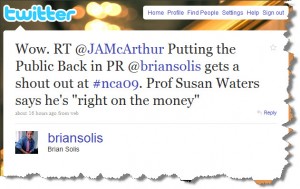
At a later session, on the use of social media in public relations classes, I asked permission to tweet, and that request was warmly welcomed by all members of that panel. So several of us DID use Twitter during that session, and we even received feedback and questions from others not attending the convention while the session was going on. We shared those tweets with the panel during the Q&A session. And to me, THAT is the power of Twitter.

solis

So here are my questions…

As a speaker, what are your thoughts on people tweeting while you speak?

As a listener, does Twitter enhance or detract from your listening?

As an association, does asking/telling members not to tweet equal a type of censorship?

I welcome your thoughts.

barbara_is_listening

Social Media Monitoring Report :: PRCA 4330

For Prof. Nixon’s PRCA 4330 Public Relations Research Class:

This assignment gives you an opportunity to learn how to monitor blog and other social media content in a way that provides similar insight offered by more traditional environmental scanning methods.

Many people will discuss your client or organization and its products/services on their own Web sites or on social media sites, outside of realm traditional media. Just as it is important for you to know what the media and your community are saying about your organization and its products/services, it is important to know what is being said in social media sites like blogs, social networks, and message boards. For this assignment, you will

  1. monitor the online conversation that has occurred about an organization or brand of your choosing since November 1, 2009
  2. create a table for your data
  3. write an analysis of the conversation with suggestions for action.

You might find bloggers who are blogging about your client organization or brand, people who are creating Web sites about it, message board members who are discussing it in forums, Twitter users who are twittering about it, social networking users who are commenting about it, or online video producers who are posting YouTube videos about it.

Let me know by November 15 how you choose to complete the project (individual or in pairs) and which organization you are choosing using this Google spreadsheet. NOTE: The first person (or pair) to “claim” a Fortune 500 company “gets” the company. No duplicates, please.

For details on the report, see below.

Social Media Monitoring Report

Many thanks to Kelli Burns, from University of South Florida, for allowing me to slightly modify a project posted at her Social Researcher blog.

PRCA 3711/4711 Portfolio Review

Sign up for an appointment for your portfolio review. The times listed in the Google Doc are the ONLY ones that will be available. There are slightly more times than we have students in PRCA 3711/4711. [As of 3:00 on November 4, about half of the spots are already taken.] The review will take about 10 minutes total.

Bring along your professional-looking portfolio with several samples of your best work, along with your resume. Review Portfolios for Public Relations Students for a reminder of how to assemble your portfolio.

Tips

Dress professionally, as you would when you go to a job interview.

Carry only the things you would for a “real” job interview (no backpacks or bulky purses).

Present the team with your business/social card, if you have one.

Expect some or all following questions:

  1. Tell me a little about yourself.
  2. What are you doing to keep current on public relations trends?
  3. Show me two pieces in your portfolio that you’re most proud of. Tell me about them.
  4. If you’re not yet published, what are your specific plans for getting published?
  5. Think about a time you were a part of a team completing a project. How did it go?
  6. All of us have some pluses and minuses in our performance; what are some of yours?
  7. After our interview today, I am going to look you up online. How do you think my impression of you will change after I do this?
  8. How do you want us to remember you?

Share a few questions that you would want to ASK in a real job interview.

Prepare a “leave-behind” for the review team, with two or three pieces you’re most proud of and a revised version of your resume. Package these items professionally. NOTE: You will NOT leave your entire portfolio with the team. The only time they will see your portfolio is during the brief time that you are together.

Points Breakdown

  • Poise, Professionalism & Confidence: 50 points
  • Portfolio Presentation: 100 points
  • Interview Q&A: 50 points