
If you’ve seen Project Hail Mary — or read Andy Weir’s novel — you already know that Ryland Grace begins with a rather significant problem:
He has absolutely no idea what is going on.
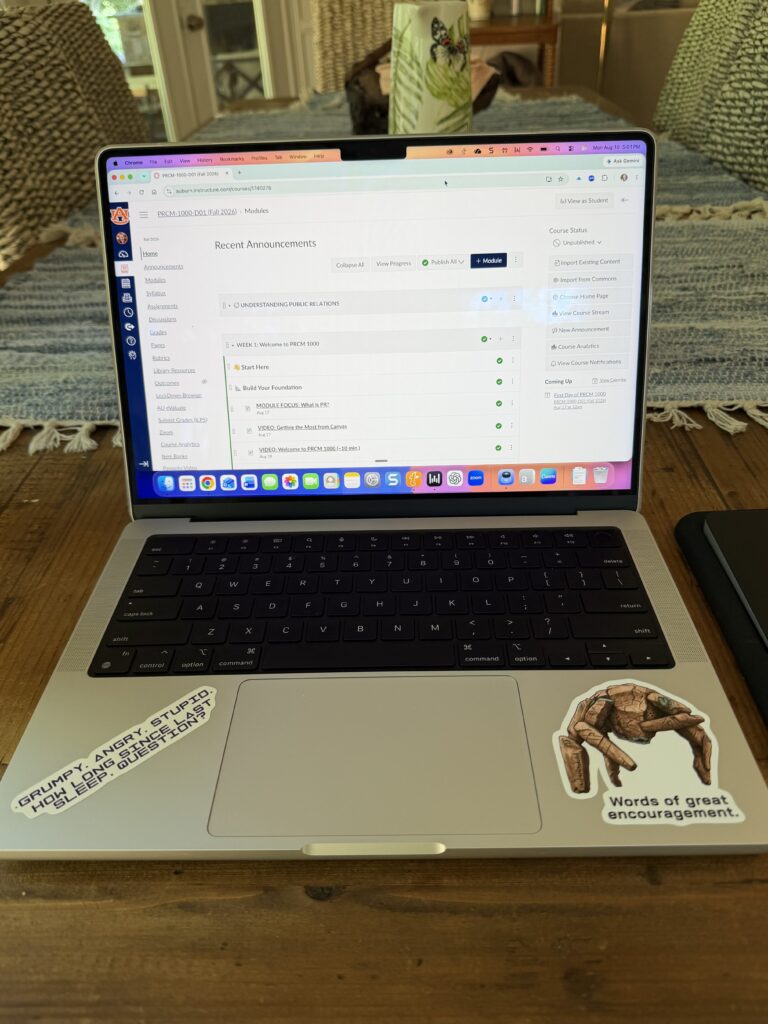
That may be a slight exaggeration of how the first week of a college semester feels, but perhaps not by much.
Suddenly you have several courses, several professors, multiple Canvas sites, assignments with unfamiliar names, due dates scattered across different weeks and perhaps a textbook or two that you haven’t even opened yet.
And somewhere in all of that, you’re supposed to figure out what you’re doing.
The good news is that you don’t have to figure out the entire semester during the first week.
That may be one of the best lessons Project Hail Mary has to offer.
Start with what you know
Grace doesn’t begin by solving the enormous problem in front of him. He couldn’t.
He starts by figuring out what he does know.
That’s not a bad strategy for a new semester.
Start with your syllabi. Look at your course calendars. Find the major assignments. Figure out which days of the week things are normally due. Check whether your professors use announcements, email or both.
Then put those things somewhere other than your memory.
I’m a big fan of Google Calendar, but I don’t particularly care what system you use. What matters is that you have one place where you can see what is coming.
You do not want to discover at 10:43 Sunday night that three things are due at 11:59.
Solve the problem in front of you
A semester can look overwhelming if you view all 15 or 16 weeks at once.
So don’t.
Certainly, you should know when your big projects and exams are coming. But once you’ve recorded those dates, bring your attention back to what you need to accomplish this week.
What needs to be read?
What needs to be watched?
What needs to be submitted?
What could you start early so Future You will be grateful?
You don’t have to complete October’s work in August. You just need to keep moving.
Pay attention when something doesn’t make sense
One of the things I like about Project Hail Mary is that problems aren’t solved by pretending they aren’t problems.
Something unexpected happens. An assumption turns out to be wrong. New information appears.
And then the plan changes.
College works that way, too.
Maybe you don’t understand an assignment. Maybe a reading takes you much longer than you expected. Maybe the study strategy that worked beautifully in high school doesn’t work particularly well in college.
Pay attention to those signals.
Then adjust.
Ask your professor a question. Visit office hours. Talk with a classmate. Try a different way of taking notes. Start the next assignment earlier.
Struggling with something is useful information — but only if you do something with the information.
You are not supposed to do everything alone
I won’t venture too far into Project Hail Mary here because I don’t want to spoil it for anyone who hasn’t seen the movie or read the book.
But I will say this:
Some problems become much more manageable when you stop trying to solve them entirely by yourself.
That applies to college, too.
Your professors are resources. Your classmates are resources. Librarians, academic support services, tutors, advisors and all sorts of other people on your campus are there for a reason.
Using those resources isn’t a sign that you aren’t capable of doing the work.
It’s part of learning how to do the work.
Keep doing the next reasonable thing
You will probably have a week this semester when everything seems to hit at once.
You may have a disappointing grade.
You may get behind.
You may stare at an assignment and have absolutely no idea how to begin it.
When that happens, resist the temptation to focus on everything that has gone wrong or everything you still have left to do.
Ask yourself:
What is the next reasonable thing I can do?
Open the assignment.
Read the directions.
Send the email.
Write the first paragraph.
Study for 20 minutes.
Put tomorrow’s deadlines on your calendar.
Then do the next thing after that.
You don’t need to have the entire semester figured out today.
You just need to know enough to begin.
And, fortunately, your semester probably does not involve saving the planet.
So you’ve already got that going for you.
A question for you:
What advice do you have for others about getting started at the beginning of a new semester?

This was a much needed reminder that everyone else is in the same boat as you, and you will get the hang of it.
If I had to give advice to someone starting the beginning of a new semester, it would be to:
1) Make a mental not (not a stressful to-do list) on what you have to get done for the day.
2) Set aside time for yourself to allow an ease into routine.
3) Go outside and pour into others. When we do this we notice how little or small our big to-do lists actually are.
I enjoyed this movie and love how it relates to so many aspects of our lives, especially starting a new semester!