Students in most of my classes have blogging as a component of their grades. Many of them have rarely even read blogs, no less written one of their own. In this post, I am combining many posts I’ve previously written to help them get started in WordPress.
1
Review the slides in my “Getting Started in WordPress” presentation below. In this presentation, you’ll learn
Blogging Do’s & No-No’s
Signing Up for Your WordPress Account
Setting Up Your Account
Writing Posts & Pages
How to Display Your Blog Comments (that you write on others’ blogs)
Watch some of the many FAQ screencasts provided by WordPress to help you with the step-by-step instructions. Here are a few of the best ones to help you get started on the right foot:
3-5-3 :: Blog Feedback for #PRCA2330 and #PRCA3330 (written for my students this past summer; the links in the post may take you to pages I wrote for other classes, but the content of the post is valuable)
4
And though you may have a good handle on the technical aspects of blogging, remember that the technical side is only part of the blogging equation. Corinne Weisgerber, a professor at St. Edward’s University and fellow PROpenMic member, created this presentation for her Social Media for PR class. The emphasis? How blogging can help you create your personal brand online. Take a look. It’s worth the time.
For this assignment (COMM 2322 only), you will choose and interview a public relations professional, and then write about this interview at your blog. This post will be a minimum of 500 words. Post your recap on your blog, and in the Course Materials area in BlackBoard, you’ll need to provide me with the PR professional’s contact information information (name, title & company, phone number and e-mail address).
Due Date: See BlackBoard
Though a face-to-face interview is preferred, a phone or webcam interview is acceptable. An interview that is e-mail or text-based only isnot acceptable.
Schedule your interview at least a week before this assignment is due, preferably two. PR professionals sometimes have unpredictable schedules, and it’s possible that you may need to reschedule.
Include an introductory paragraph that introduces the PR professional, including title and company, educational background, etc. Mention your connection to the professional (how you found him/her) and how you conducted the interview (face-to-face, phone or webcam).
Questions/Topics you need to include:
What’s a typical week like? (If no week is typical, then what was last week like?)
Tell me about a project you worked on that you are especially proud of.
What do you do to keep current in the PR industry?
What do you wish you would have known before starting your career in PR?
How important is writing in your career?
What three tips would you offer someone just starting out in PR?
After interviewing this person, are you (the student, not the practitioner) more or less likely to want to have a career in PR? Why?
Some questions you may wish to ask:
Did your education prepare you for working in PR? How?
What has surprised you the most about working in PR?
How has PR changed since you entered the field?
How does technology affect your daily work?
When your company is hiring for an entry-level PR position, what makes a candidate stand out?
What professional organizations are you involved in? (For example, PRSA, IABC, etc.)
Include a photo of your interviewee. (This can be a photo he or she provides or one that you take yourself.)
Link to your interviewee’s LinkedIn profile and/or blog.
Conduct the interview using Skype and two webcams. Record the interview with Vodburner, and post the interview at your blog.
Questions?
[NOTE: This must be an informational interview that you conduct this semester. Do not “recycle” an interview that you conducted during a previous semester.]
In our PR Writing classes (PRCA 3330 at Georgia Southern University and COMM 4333 at Southeastern University), we’ll all blog about the same general topic each week during the semester. Your TOWs of 300 words or longer are due (should be posted on your own blog) by Saturday at 11:59 p.m. at the end of each week.
If a week has more than one topic listed, choose one of the available topics on those weeks.
If you are unsure how to get started writing these TOWs, many times you can use this three-pronged approach:
What did you learn?
What surprised you?
What do you want to know more about?
WEEK ONE
Which types of social media you currently participate in (such as blogging, podcasting, social networking, etc.), which platforms you use, and why. [NOTE: Since you are creating your blog after after Week One, you will go back and add this post in.]
WEEK TWO
Visit Mignon Fogarty’s Grammar Girl’s website. Either read one of her blog posts or listen to one of her podcasts on an area of grammar that is troublesome to you. Write about what you learned (using the three-pronged approach described toward the top of this blog post.)
WEEK THREE
Why are comments such an integral part of blogs? What advice would you offer on writing effective blog comments?
WEEK FOUR
Last week, you took the NewsU Cleaning Your Copy course. There were four main topics in this course: Grammar, AP Style, Punctuation and Spelling. Using the three-pronged approach described at the top of this post, describe your reactions to this course. Remember to include a hyperlink to the course, too.
WEEK FIVE
Chapter 3 in your Public Relations Writing and Media Techniques book discusses ways that public relations practitioners can avoid legal hassles. One of these ways is to avoid plagiarism. Based on what you read in the chapter and additional research you will do online, what are some of the best practices (tips & tricks) for avoiding plagiarism in your writing?
WEEK SIX
What makes a story newsworthy?
WEEK SEVEN
One Week of Twitter [Note: You will do the One Week of Twitter assignment during Week Six, and then write about it before the end of Week Seven.]
WEEK EIGHT
Last week, you took the NewsU The Lead Lab course. Using the three-pronged approach described at the top of this post, describe your reactions to this course. Remember to include a hyperlink to the course, too.
WEEK NINE
Create a profile at PR OpenMic, a social network developed by Auburn University’s Robert French. Connect with me there as a friend so that I know you have joined. Then for your topic of the week, describe what PR OpenMic has to offer to PR students and recent grads. Be sure to discuss at least three or four things you encounter at the site, and provide hyperlinks to the specific areas in the site for your readers.
WEEK TEN
In WordPress, go into your Dashboard and take a look at your stats. What kinds of things does the Site Stats page tell you? How would PR practitioners benefit for monitoring their own or their company’s blog?
WEEK ELEVEN
Address several of the following questions about infographics. What are they? How could one be useful in a story for your client? How do you go about creating one? Create one if you can, and embed it in your blog post this week.
WEEK 12
Listen to at least one hour of PR/marketing podcasts (such as For Immediate Release, Inside PR, The Creative Career, Coming Up PR, Trafcom News or Marketing Over Coffee). Briefly summarize what you heard. Discuss how listening to PR podcasts can benefit PR students or new PR practitioners. Be sure to include a hyperlink to the podcast’s website/blog. (Optional: Also, write a short review of the podcast at iTunes.)
WEEK 13
Working either alone or in a group of no more than three, create a list of at least 10 ways that PR people can sometimes drive journalists crazy. After each item on the list, indicate what the PR person could/should do instead. Hyperlink to sources as needed. (If you are working with others, each of you should post to his/her own blog, and note where else it is crossposted and who the co-authors are.)
WEEK 14
During Week 14, you will take the Five Steps to MultiMedia Storytelling course at News University. Using the three-pronged approach described at the top of this post, describe your reactions to this course. Remember to include a hyperlink to the course, too.
WEEK 15 (Optional)
Just what is a “Social Media News Release”? When should a PR practitioner use a SMNR rather than (or perhaps in addition to) a “regular” news release? Be sure to include links to at least three websites/blogs that discuss SMNRs.
WEEK 16 (Optional)
What advice would you offer PR students who are new to blogging? Come up with your own Top 10 list.
As our semester begins at Georgia Southern, students are asking me questions via e-mail about our online classes. Rather than responding individually (so only one student can benefit), I’ve created a list of FAQs so that all can benefit.
1. How do I find out when things are due? (And will you make us a calendar for all the due dates?)
The quickest, easiest way to find out due dates for assignments is to look at the Calendar feature in GeorgiaVIEW. You can also find due dates for Assignments on the Assignments tab and RATS/quizzes on the Assessments tab. [NOTE: Blog posts are the exception. Weekly blog posts are due in this class, and they will not appear on the GeorgiaVIEW Calendar.]
2. Why do we need a headset/mic? What kind should we buy?
For the times that we’re meeting online at the same time (synchronously), you will need to be able to hear what I am saying and occasionally respond by voice. You can find inexpensive ones at Amazon, OfficeMax or Walmart.
3. What’s expected in our blogs?
See the post I’ve written about blog content for your specific course:
PRCA 3330: PR Writing (coming soon)
4. I will be out of town for a week. Will that impact my grade in this course?
Since our class is online, your engagement and participation will be evaluated by your continuous completion of assignments and blog posts. If you are out of town, just be sure that you are keeping up with due dates.
5. What’s the “Public Relations Matters” section on our GeorgiaVIEW home page for?
At the bottom of each page for our course in GeorgiaVIEW there is a section titled “Public Relations Matters.” What you will see there is an RSS feed of the last four blog posts that you find here on my blog. It’s just a quick and easy way for you to see what’s new on my blog.
6. When will we be meeting synchronously (online at the same time)?
We will meet on Mondays at 5 p.m. in the Wimba Live Classroom in GeorgiaVIEW. (NOTE: We will not meet EVERY Monday, but to start the semester, we will meet most of the Mondays.) If you cannot attend a session, you’ll have the opportunity to view the “archive” (replay) of the session at a later time. After the first week of class, when I schedule a synchronous session, I will always send a meeting notice to you via Google Calendar. Please either accept or decline the notice so I can know who will attend.
7. Can I use my Gmail (or other account) instead of my Georgia Southern account for e-mail?
For consistency and reliability, GeorgiaSouthern requires faculty members to use our university-provided e-mail accounts for communicating with students. What you may want to do is set up your Gmail to automatically fetch your GSU e-mail, so you’ll only have one place to look. (That’s what I do.)
8. How often should I check my e-mail?
Check your e-mail at least once a day, preferably more. For our class, I will not send you a same-day assignment; I don’t think that’s fair. But I do send occasional reminders or clarifications that could help you with assignments you are working on. I also typically will send a tweet (on Twitter) letting you know to check your e-mail.
9. How will you do your office hours?
You’ll be able to find me in a Wimba Live Classroom (found on your class’ GeorgiaVIEW home page) quite often throughout the week. My office hours are held in the room labeled Virtual Office for Prof. Nixon’s Virtual Office. When I am in there, you can ask questions via chat, audio or audio & video; I can respond using the same methods. Remind me which class you are in when you stop by my virtual office.
10. My other professors haven’t used GeorgiaVIEW as much as you are using it. Can you show me how to use it?
GeorgiaSouthern has created several tutorials on using GeorgiaVIEW. Spend some time reviewing these tutorials; it will be worth the time you invest. I also created a short overview of how I use it. It’s best to ask another classmate first, then come to me if you have further questions on GeorgiaVIEW.
This fall, I am working with a university to develop an online version of its traditional classroom First-Year Experience class for incoming freshmen. Even though as a parent of a college almost-senior and a college freshman I feel like I keep up with trends, it’s always good to check out Beloit College’s annual Mindset List to help understand some of the cultural references that are common to students entering college now.
And why is this type of list important for educators? It helps us to remember to keep the examples we use in class fresh and relevant. I recall the sounds of crickets chirping in the room a few years ago when I asked if anyone could relate to having an Arnold Horshack in the class with them. Don’t want that to happen to me again. Or to anyone else.
The complete list is at Beloit’s site; I’ve extracted a few of my favorites from the annual Mindset List below:
For these students, Martha Graham, Pan American Airways, Michael Landon, Dr. Seuss, Miles Davis, The Dallas Times Herald, Gene Roddenberry, and Freddie Mercury have always been dead.
They have never used a card catalog to find a book.
Tattoos have always been very chic and highly visible.
They never saw the “Scud Stud” (but there have always been electromagnetic stud finders.)
Babies have always had a Social Security Number.
They have never had to “shake down” an oral thermometer.
American students have always lived anxiously with high-stakes educational testing.
There has always been a Cartoon Network.
We have always watched wars, coups, and police arrests unfold on television in real time.
Ozzy Osbourne has always been coming back.
There have always been flat screen televisions.
Everyone has always known what the evening news was before the Evening News came on.
They have never been Saved by the Bell.
Most communities have always had a mega-church.
Nobody has ever responded to “Help, I’ve fallen and I can’t get up.”
"there is nothing wrong in this whole wide apartment" by tizzie
If you’re looking to get a jumpstart on my classes at this fall, here are the books that I will be using. I’ve linked to many of them at Amazon.com, but of course you can purchase them from anywhere you like. I recommend you try the Facebook Marketplace first, so you can get a good deal AND help a fellow student.
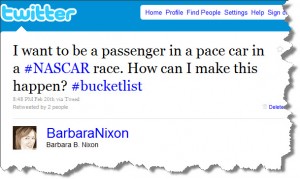
One day in February, not long after my husband Kevin and I went to the PotholeDaytona 500, I tweeted that one of the things on my bucket list was to ride in a pace car during a NASCAR race.
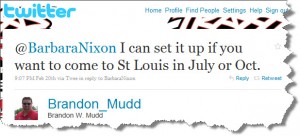
I wrote it not thinking I’d get much of a response other than maybe a “me, too” from another NASCAR fan. But was I ever surprised when Brandon Mudd, the Public Relations and Media Manager for Gateway Raceway, replied to me a few minutes later.
My first reaction was, “Yeah, right.” Then after a few Twitter, LinkedIn and e-mail interchanges, I realized that this was actually going to happen. All I had to do was get myself (and my hubby) to St. Louis the weekend of July 16 & 17.
Gateway Raceway provided my husband Kevin and me with Hot Pit / Garage / Media Center passes, along with passes to Victory Circle, and even Infield Parking. If you’re not a NASCAR fan this is what it means:
Hot Pit Passes: We were able to stay in the pit area (where the car & truck teams are during the race) before and through the entire race, meeting as many drivers and teams as we wanted to. We just had to be sure to stay out of their way when they were working.
Garage: We could see what the teams were doing to get the cars & trucks set up for the races.
Media Center: We had a place to cool off and relax a bit. The temps were into the 100s, and it was 135 for a while on pit road.
Victory Circle: Before and after the races, we stood in the Victory Circle area. I was able to get a lot of great pictures of drivers chatting with each other before the driver intros, and I was right there as Kevin Harvick drove up his winning truck for the CampingWorld.com 200 race. We even got to see the infamous Hat Dance.
Infield Parking: This made it easy for us to go back to our car as needed to cool off and get refreshments. For a while, we even turned the car around so it was facing the track, and watched parts both races from the air-conditioned comfort of our cars.
On Friday afternoon, we arrived at the track and milled around in the pits and garage area for a few hours before the scheduled start of the CampingWorld.com 200 NASCAR Truck race. As it came time for the pre-race festivities to start, I noticed some pulled-aside conversations going on in Victory Circle. The power had just gone out (momentarily, we thought). It was still daylight, and the loudspeakers worked via generator, so most of the pre-race could happen planned, while we waited for the power to kick back on.
They did the driver intros, which was fun to watch from behind the scenes as the drivers chatted with and teased each other as they waited their turn to be introduced in qualifying order.
Then it was time for the National Anthem. Lincoln Brewster, lead singer and guitarist for a Christian band, prepared to play the song. But there was no power for his electric guitar. He was urged to just sing it a capella, like it’s usually done . . . but he admitted he didn’t know all the words! Yikes. So then it was time to watch Brandon and his team scramble around to find someone who — with no notice or practice — could and would sing the National Anthem before a NASCAR race, on national television. (I would have volunteered, but I think my hubby of almost 25 years would have walked out on me if I did. And if you heard my singing voice, you’d have turned the channel quickly, too!)
All of a sudden, NASCAR’s Jimmy Small volunteered to sing it. Whew! Crisis avoided. Jimmy approached the stage . . . then the power came back on enough for Lincoln Brewster to go ahead with his Jimi Hendrix-inspired rendition of the National Anthem.
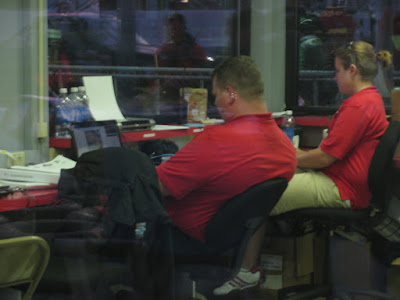
And the power stayed off. As it turns out, there was a major power problem offsite. Brandon wrote and distributed a news release from the Media Center with the details. I just happened to peek through the window as he was writing.
The truck race was delayed until Saturday at 12:30 . . . which meant that the nice, coolish evening race we had planned for was now going to be a part of a LONG double-header day of racing on Saturday.
We went back to the hotel to cool down, then headed back to the track on Saturday morning after a fantastic breakfast of the best corned beef hash I’ve ever had at Crepes, Etc. We made a quick stop for supplies, including some Baskin and Robins hard candy for Tati Papis, who had recently lamented on Twitter that the ice cream lady at the track was nowhere to be found.
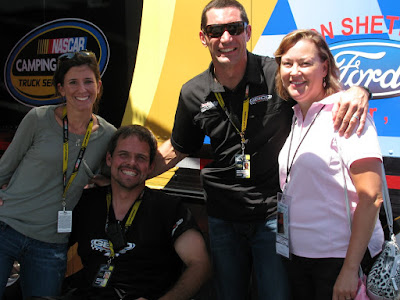
Our first stop when we got back to the track was at Max Papis‘ hauler. I think I surprised Max when I introduced myself to him (trying not to sound like a fangirl!), but then asked for him to see if his wife Tati would come out. I gave the ice cream candies to a laughing Tati. Then Tati, Max and his crew chief Bootie Barker posed for a photo with me. Nice folks, all of them!
Here’s some video I took with my Flip camera of the CampingWorld.com 200 race (before, during and after), including the Hat Dance by race winner Kevin Harvick and his team. This short video includes the command “Drivers start your engines,” trucks rolling off pit road, racing to green, a few pit stops, then the post-race in Victory Circle.
For the next few hours, we milled around in the pits, the garage and the media center. I took about 250 pictures that day. You can see the best of them in my Picasa web album.
Finally it was time for what I (thought I) had come to the track for: my ride in a pace car during a race, the Missouri-Illinois Dodge Dealers 250 to be exact. The National Anthem was sung without a hitch, then Brandon walked me down pit road for my ride in the car. I took video with my Flip camera (from the back seat) throughout the two laps I had on the track.
The Bottom Line: I was able to cross one item off my Bucket List. The ride was fun, and I came away with even more. Throughout the weekend at Gateway Raceway, I was constantly amazed by how approachable the drivers are and how much access the fans have to them. What other sport lets you up so close, not just before a game, but during?
Many, many thanks to Brandon Mudd for responding to my tweet that I thought would go unanswered.
(PS: A Confession :: We didn’t stay until the end of the Nationwide race to see Carl Edwards win. We were exhausted and drained from the 100+ temps, even though we’re Floridians now and drank more than a gallon water each during the day. We listened to the race on MRN radio in the car on the way back to our hotel, then watched the final 50 or so laps from our air-conditioned room with our feet up — and lots of great memories of the day.)
In my Introduction to Public Relations and Public Relations Writing classes at Georgia Southern this summer, a large portion of the students’ grades came from their blogs. Most of the students in this class had never even read a blog before the beginning of the summer, no less written one of their own. For their final Topic of the Week, I asked them to create a list of tips for PR students new to blogging. Here, I will share some of the best tips:
The first thing to remember about blogging is to have patience. At first you will not have many visitors to you page accept you teacher and maybe a few classmates but if you continue on, the readers will come.
Don’t Treat the Blog like Homework! I know since this is all for a class, some people dread working on these assignements. Take in consideration that the teacher is not doing it to torture you. This is part of your career!
Make sure to proofread often. I am not an avid blogger but when I would go to a person’s blog and see that every other word was misspelled or their grammar was poor I moved onto someone else’s blog. One advantage of using Word press is that it offers a proofreading section to make sure you do not have a ton of misspelled words on your blog.
Media. Despite my taste for traditional writing and structure in blogs I can tell you first hand that adding media such as images, videos, and other interactive applications is a great way to keep your blog fun and entertaining. Now this is subject to change depending on your target audience and the purpose of your blog. In general it is a great idea to give some visual content to your writing in any blog.
Post your blog on other websites you are part of such as Twitter and Facebook. By doing this you will have more followers and interaction with your blog.
Try to find videos and pictures that complement your post. Blog posts that are full of text can look bulky. Use pictures to break up long paragraphs or add a YouTube video that relates to your topic to add variety.
Be creative with your headline. Your blog may be very good and interesting, however if the headline is boring then the viewer may not read past the headline.
Link. When blogging, it is important to let your readers know what the source of your information is, if you have one. Be sure to link certain parts of your post in order to guide readers in the direction of more information on what the post is about. This also gives credit where credit is due in order to avoid plagiarism.
Whenever you are given leverage to choose your own topic [like for your PR Connections], try to relate PR with something you are passionate about. If you have a strong opinion about a topic, you should have less trouble overcoming potential writer’s block.
Lastly, have fun! It may seem like a task at first, but there is a thrill in having people show interest in your thoughts. This experience helped me acquire clarity about several issues I once believed myself to be educated on. That’s it, remember to enjoy.
So that’s what my summer PR students had to say. What other recommendations do you have for PR students starting off with a new blog?


 As our semester begins at Georgia Southern, students are asking me questions via e-mail about our online classes. Rather than responding individually (so only one student can benefit), I’ve created a list of FAQs so that all can benefit.