Why Watching and Reading Isn’t Enough: The Case for Taking Notes by Hand in Online Courses

If you have ever finished watching a lecture video or reading a chapter and thought, “Yep, I’ve got this,” only to blank during a quiz later, you are not alone. This is especially common for first- and second-year students who are new to online asynchronous courses. Without scheduled class meetings or live discussions, it is easy to assume that exposure equals learning. NATTAROR’S VOICE: “It doesn’t.

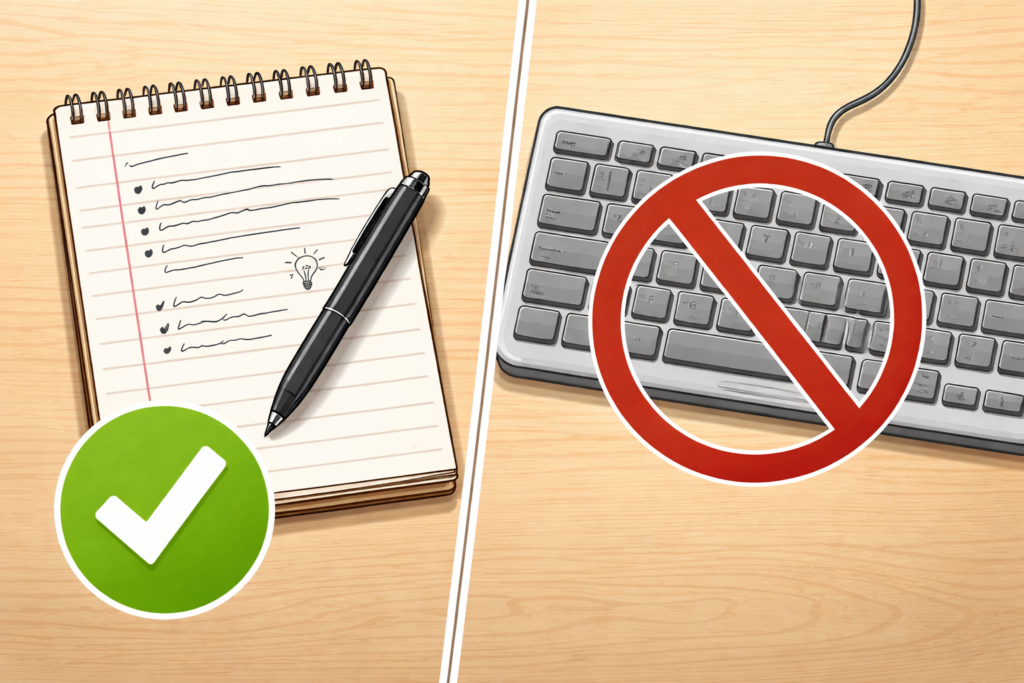
But reading something once or watching a video straight through does not mean it has stuck. Learning requires effort, and one of the most effective ways to create that effort is taking notes by hand. Yes, by hand . . . like with a pen or pencil, NOT a keyboard.
The Illusion of Learning in Online Courses

Online asynchronous courses create a unique challenge. You can pause videos, replay lectures and scroll back through readings whenever you want. That flexibility is helpful, but it also creates a false sense of confidence. When information feels familiar, your brain interprets that familiarity as understanding.

This is known as the illusion of learning. When you read or watch passively, your brain is recognizing content, not necessarily remembering or understanding it well enough to use later. Recognition is much easier than recall, and most exams, assignments and discussions require recall.

Handwritten note-taking interrupts that illusion. It forces you to slow down, decide what matters and put ideas into your own words.

Why Writing by Hand Helps You Remember More

Research consistently shows that writing notes by hand leads to better understanding and longer-lasting memory than typing or simply rewatching content. When you write by hand, you cannot capture everything word for word. That limitation is actually a strength.

Handwriting encourages:

  • Active processing: You must listen or read, decide what is important and summarize it.
  • Deeper encoding: Translating information into your own words helps move it into long-term memory.
  • Stronger recall: The physical act of writing engages multiple areas of the brain tied to learning.

Typing, by contrast, often becomes transcription. You can keep up with the speaker without thinking deeply about what is being said. Watching without note-taking is even more passive.

For students in asynchronous courses, where there is no immediate instructor feedback or peer discussion, handwriting becomes an especially powerful way to replace some of that missing interaction.

Notes Are Not a Transcript

One reason students avoid handwritten notes is the belief that notes must be complete or perfect. They do not.

Effective notes are not a copy of the lecture or reading. They are a record of your thinking about the material. That means incomplete sentences, arrows, questions in the margins and diagrams are not signs of poor notes. They are signs of active learning.

Instead of trying to write everything down, focus on:

  • Key concepts or terms that appear repeatedly
  • Examples that clarify difficult ideas
  • Questions you still have after watching or reading
  • Connections to earlier material or real-life situations

Practical Note-Taking Strategies for Asynchronous Courses

If you are new to online learning, the structure is often the hardest part. These strategies are designed specifically for asynchronous courses.

1. Pause the Video on Purpose

Do not watch lecture videos straight through. Pause every few minutes and write down:

  • One main idea
  • One detail that supports it
  • One question you still have

This prevents passive watching and keeps your brain engaged.

2. Use the Cornell Method (Lightly)

Try this. Divide your page into three sections:

  • Main notes: During the video or reading
  • Questions or keywords: Added afterward
  • Summary: Two or three sentences at the bottom explaining what you learned

You do not need to follow this perfectly. The structure simply helps organize your thinking.

3. Handwrite First, Then Type if Needed

If you need digital notes for accessibility or organization, start by handwriting. Later, type a short summary from your handwritten notes. That second pass strengthens memory and highlights gaps in understanding.

4. Write Before You Rewatch

If something feels confusing, write down what you do understand before rewatching the video. This makes the second viewing more focused and efficient.

5. Keep One Notebook Per Course

Mixing courses in one notebook increases cognitive load. Keeping one notebook per class helps your brain create clear mental categories, which improves recall.

Handwritten Notes Help with Studying, Too

Another advantage of handwritten notes is how useful they are later. Reviewing notes you wrote in your own words is far more effective than rereading the textbook or rewatching videos.

Before quizzes or exams, try this:

  • Cover your notes and write out what you remember
  • Check your notes to see what you missed
  • Rewrite only the unclear sections

This kind of retrieval practice is far more effective than passive review.

A Final Reminder for Online Students

Online asynchronous courses reward independence. That freedom can be empowering, but it also requires intentional study habits. Handwriting your notes is one of the simplest changes you can make that has an outsized impact on learning.

You do not need fancy supplies, perfect handwriting or beautifully organized pages. You just need a pen, paper and the willingness to slow down and think.

Watching and reading introduce information. Writing by hand helps you actually learn it.

A Question for You

Do you have any other tips on notetaking, especially for online, asynchronous courses? Please share them in the comments.
Signature Block: I'm listening, Barbara

Author’s note: This post began as a draft created with the help of ChatGPT and was revised, edited and customized by me for accuracy, clarity and relevance to my students. I use generative AI as a starting point for ideas, not a substitute for teaching expertise or judgment.


How ProctorU Protects Your Grades (and Your Integrity)

When you hear the word “proctor,” you probably don’t get excited. Maybe it makes you think of someone hovering behind you while you take a test, watching your every move. And yes, using ProctorU — an online proctoring service — can feel intimidating at first. But here’s the thing: ProctorU isn’t your enemy. In fact, it’s here to help you.

Let’s talk about why ProctorU is actually a good thing for you as a student.


1. It Levels the Playing Field

Have you ever sat in a class where you studied hard for a quiz, only to hear later that someone else found a “shortcut”? Cheating is frustrating because it puts honest students at a disadvantage.

With ProctorU, that’s not the case. Everyone is held to the same standard. When you log in to take a quiz or an exam, you can feel confident knowing that your effort counts. No one else is getting an unfair advantage. That’s a big deal — it means your grade really reflects your knowledge, not someone else’s shortcuts.


2. It Protects Your Academic Integrity

Think of ProctorU as a shield for your academic reputation. One of the most valuable things you’ll take away from college is your integrity. When employers or grad schools look at your transcript, they want to trust that the grades you earned represent your own work.

Using ProctorU helps guarantee that. You’re showing your professors, your school, and ultimately yourself that your work is honest. It’s proof that you did things the right way. That matters not just now, but years from now when your degree is part of your professional identity.


3. It’s Just Like Taking a Quiz in a Classroom

If you’ve ever taken a test in a lecture hall, you’ve already experienced the same concept as ProctorU. Instructors walk around the room, making sure students aren’t whispering answers or sneaking notes. ProctorU is simply the digital version of that.

Yes, it feels different at first. You’re on your laptop at home instead of sitting in a classroom. But the principle is the same: a fair, distraction-free environment where everyone is accountable. If anything, you might find it less stressful — no shuffling papers, no coughing in the background, just you and your screen.


4. It Helps You Stay Focused

Believe it or not, having a proctor (even a virtual one) can actually help you focus. When you know that your test environment is being monitored, you’re less likely to get distracted by your phone or wander into “just five minutes” of social media scrolling.

Instead, you’re locked in, focused on the task at hand. That extra accountability can actually improve how you perform because you’re giving your full attention to the quiz.


5. It Prepares You for the Real World

In many professional fields, assessments, certifications, and even some job interviews are proctored online. ProctorU is practice for that. You’re learning how to set up your space, follow clear rules, and demonstrate your knowledge under fair conditions.

Rather than thinking of it as a hassle, consider it training for what’s to come. The ability to perform honestly under pressure is a skill that will serve you long after you graduate.


Final Thoughts

At first, ProctorU might feel like “Big Brother” is watching. But once you understand what it’s really about, it makes sense. It’s not about catching people doing the wrong thing. It’s about making sure everyone has the same fair shot and that the work you put in actually matters.

So next time you log in to take a quiz or exam with ProctorU, think of it the same way you’d think of walking into a classroom test: it’s your chance to show what you know. And when you walk away, you can feel good knowing that your grade is truly yours.

What are YOUR thoughts on using something like ProctorU? Do you have tips to share?

Signature Block: I'm listening, Barbara

(Image created with the assistance of ChatGPT 5.)

College Life Can Be Hard. These 60-Second Videos Make It Easier.

College students, this one’s for you.

My Arrive, Survive & Thrive video series is officially live — and it’s here to help you navigate college one 60-second tip at a time.

Each video covers a different aspect of college life — from navigating roommate situations and staying on top of assignments to figuring out how to talk to professors or make the most of group projects. The tips are quick, practical, and sometimes even funny (depending on the day).

Whether you’re a first-year figuring things out, a senior in high school getting ready to launch, or somewhere in between — this series was made with you in mind.

Here’s your next move:
Pick your favorite platform — Instagram, TikTok, Facebook, or YouTube Shorts — and follow me there. That way, the tips come to you when you need them most: between classes, waiting for your latte or in a late-night scroll session.

Some recent topics:

The goal? To help you feel more prepared, more confident, and less alone in your college journey.

Let me know in the comments: What college questions or challenges should I cover next?

Signature Block: I'm listening, Barbara

Sparkle Up Your Semester: What Taylor Swift’s Orange Glitter Meme Can Teach You About College

If you’ve been anywhere near social media lately, you’ve probably seen the bold, sparkly orange glitter background from Taylor Swift’s new album era. It showed up in her promotions, podcast covers, and across fan memes—and whether you’re a Swiftie or not, you’ve got to admit: it grabs your attention.

That’s exactly the point.

In the world of college life, there’s a simple takeaway from this viral trend: make the small things stand out. In other words, embrace your own version of the orange glitter background.

Let’s face it—college is full of details that are easy to overlook. Deadlines, reminders, messages from professors, group chats, or even the reading assignments that quietly show up in your learning management system. But when you add a little flair, you make those things stick.

Try these “Orange Glitter” Moves:

  • Highlight your planner with bright colors. Orange for deadlines. Pink for tests. Blue for self-care. Make it visual and fun.
  • Add a little sparkle to your notes. Sticky flags, doodles, or even color-coded pens can help key concepts pop.
  • Send better group chat messages. That doesn’t mean flooding the group with emojis—but a single well-placed GIF or bolded sentence can make your message stand out.

These small, playful changes do more than just look good—they help your brain focus, organize, and remember. And let’s be real: if it worked for one of the biggest album drops of the year, it can probably work for your Chem 101 reminders too.

Bottom line: When your semester starts to feel gray, throw a little orange glitter at it.


What’s one way you make your school routine more fun or memorable? Let me know in the comments—and don’t forget to follow along for more tips on arriving, surviving, and thriving in college.

Launching August 1: Arrive, Survive & Thrive — Essential Tips for College Success

College students, this one’s for you.

Starting August 1, I’m launching a new video series called Arrive, Survive & Thrive — and it’s all about helping you navigate college life one 60-second tip at a time.

Whether you’re a first-year student trying to find your footing, a high school senior getting ready for the transition, or even a seasoned sophomore or junior looking for smarter strategies, this series is designed for you. (Your parents can even benefit from this series.)

Each video tackles a single topic in less than a minute — from navigating roommate dynamics and making the most of group projects, to setting up your study system and talking to professors with confidence. You’ll find videos that are encouraging, practical, even a little funny — depending on the day.

The goal? To help you feel more prepared, more confident, and less alone in the college experience.

You’ll find the videos on Instagram (and Facebook), TikTok and YouTube Shorts starting August 1 — just in time for back-to-school. Watch them between classes, while waiting for your coffee or anytime you need a quick dose of support and strategy.

So whether you’re arriving for your very first semester, figuring out how to survive the challenges or ready to thrive in new ways — these tips are for you.

Let me know in the comments: What college questions or challenges should I cover in the series?

Let’s do this—together.

Signature Block: I'm listening, Barbara